Catch it before it ships.
A bad unit gets caught at the bench, not by your customer. Define each check once and it raises itself at the right moment — every failure flagged the instant it happens.
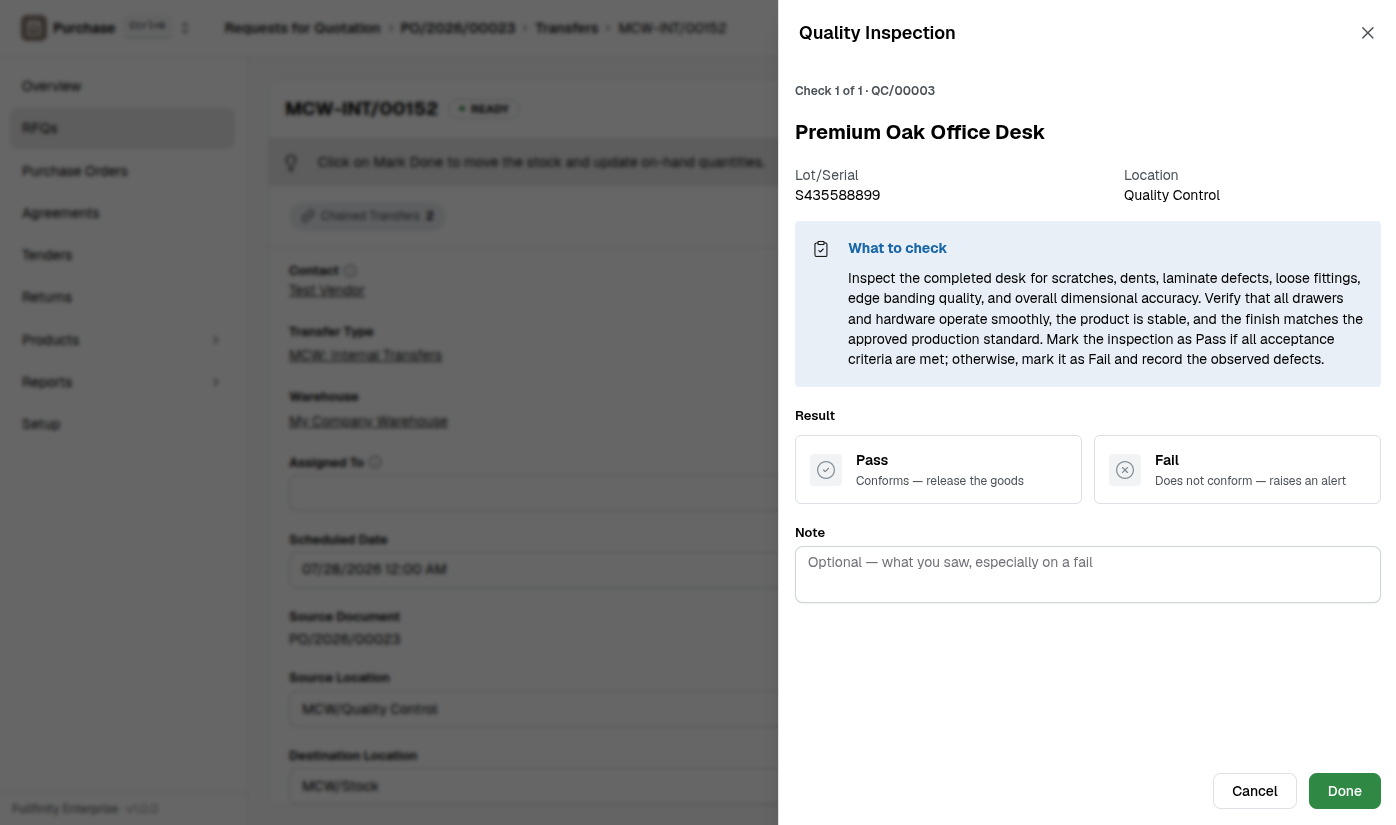
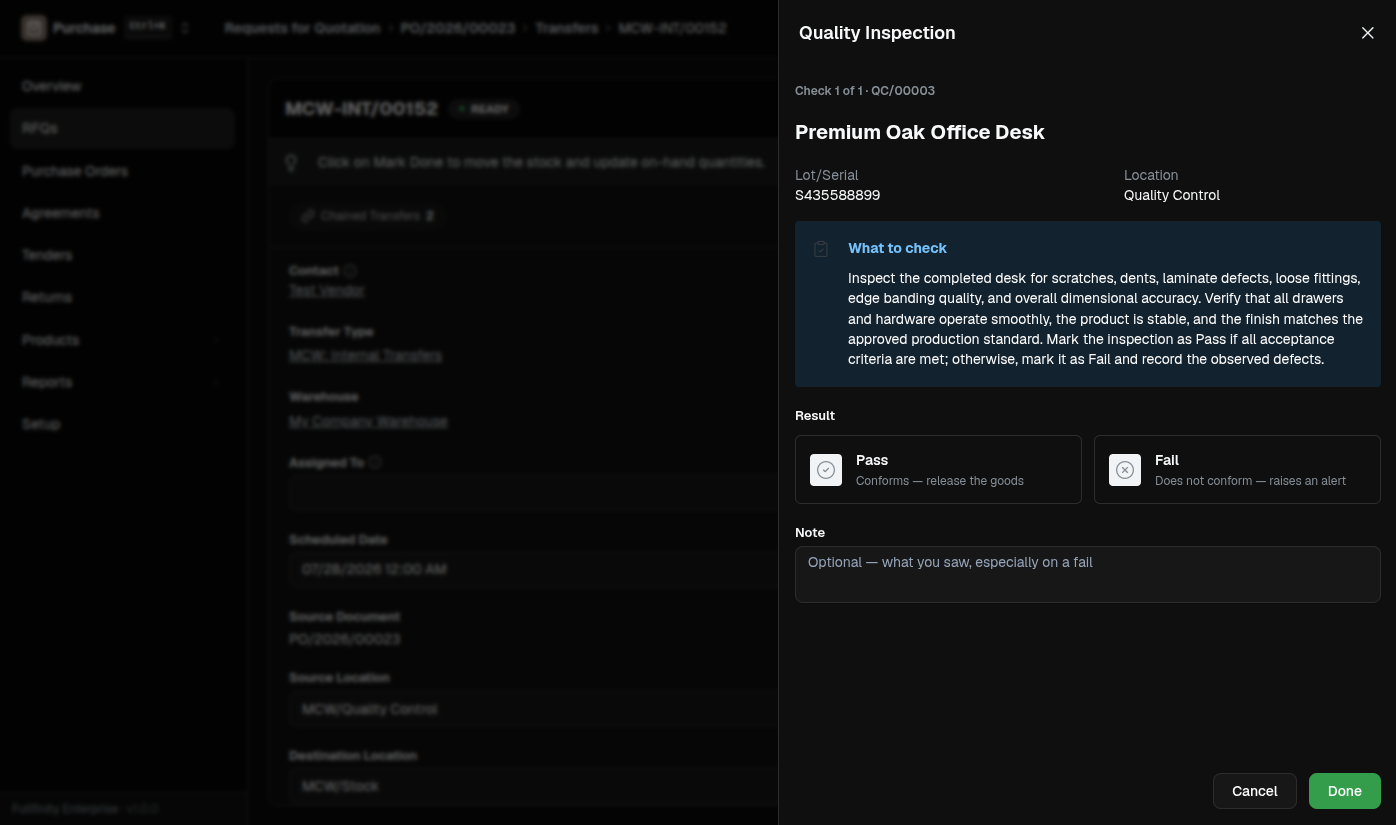
A checklist in a binder isn't quality control.
Inspections live on paper or in a spreadsheet nobody links to the actual order — so a failure is a note in a folder, not a signal that stops a bad unit leaving the building. By the time it's found, it's a customer's problem.
Define the check once. It raises itself.
A control point says what to inspect, on which product or operation, and how often. From then on the check appears at the right moment — receiving a shipment, finishing a work order — against the right product and lot. No one has to remember to start it.
Out of tolerance raises an alert — automatically.
Record a reading outside the min/max and the check fails on the spot, and a quality alert is raised — escalated and visible to the team, not a red cell in a spreadsheet. The bad unit is stopped where it stands, before it moves down the line.
One connected system
The same customers, products and stock run through Quality and every other app — nothing kept in a separate tool.
Open-core
The core apps are open source, and the whole thing is yours to self-host.
Free, unlimited users
Self-host the Free edition with your whole team on it — no per-seat fees, no seat counting, no trial running out.
Only what you need
Run Quality on its own, and switch on the rest of the suite when you're ready.
Quality management, answered.
How do checks get created — do I raise them by hand?+
No. You define a control point once — what to check, on which product or operation, and how often — and the system raises the check at the right moment. Every inspection lands in one place, ready to record.
What kinds of checks can I run?+
Pass-Fail for a simple yes/no, Measure for a reading against a min/max tolerance (out of range fails automatically), and Instruction for a step to follow. One control point, the right check type for the job.
What happens when something fails?+
A failed check raises a quality alert, so a problem is escalated and visible instead of buried in a checklist. You catch it before it ships, not after a customer does.
Where does Quality plug in?+
Into the operations that already run — receiving a shipment, finishing a work order. The check is raised in the same flow, against the same product and lot, so quality is part of the process, not a separate binder.
Which plans include Quality?+
Quality is part of the Standard and Enterprise plans. It runs on the same catalog, stock and operations as the rest of your business.
Apps that pair with Quality
Run Quality — and the rest of your business — in one place.
Join the waitlist and be first through the door when Fullfinity launches.
Join the waitlist